Dynamic Pricing Raised CO₂ Emissions in 8 of 20 European Countries: Cheap Power Does Not Always Mean Clean Power
For asset managers, this might sound like an appealing pitch- shifting electricity consumption to low-price periods promises lower costs and reduced emissions at the same time. And while cheap electricity sounds like clean electricity, even in the cheapest hours, the power may come from a coal plant. This is the merit order effect. Across the electricity market, generators with the lowest marginal costs are switched on first, while those with the highest marginal costs are brought in only as demand rises. A study published in Applied Energy found that dynamic electricity prices rarely reduce overall energy use and offer no guarantee of lower CO₂ emissions. Part of the reason is that a low price only tells you which plant is cheapest to run in each hour, not which one produces the cleanest energy. In many grids, that extra kilowatt-hour is covered by lignite or coal.
According to the Energy economy Act, since 1 January 2025, all German electricity suppliers must offer dynamic prices to customers with a smart metering system; Austria rolled out 96.9% of its metering points with smart meters by the end of 2024, based on an Austrian energy reporting article.
Cheap electricity does not always correlate to lower CO2, plus a dynamic tariff only addresses the wholesale price, which is just one part of a commercial customer's bill, according to the German Federal Association of Energy and Water. The previously mentioned study published in Applied Energy provides clear figures regarding how shifting load to cheap hours often increases total CO2 consumption.
The main findings of the study were:
- The diversity of EU countries in terms of the composition and the size of their national electricity supply systems is reflected in the grid mix emission factor and marginal emission factor.
- Price-based load shifts raised operational emissions in 8 of 20 countries by 2.1% on average.
- Under some circumstances, shifting load based on marginal emissions led to an average cut emission by 35% however decreasing cost saving potential by 56% compared to the price-based shifting.
While price-based demand response leads to negative environmental effects under specific circumstances, it can be a very promising method of reducing operating cost and carbon emissions when adequate carbon prices are implemented.
Load shifting in Europe:
why the choice of carbon signal matters
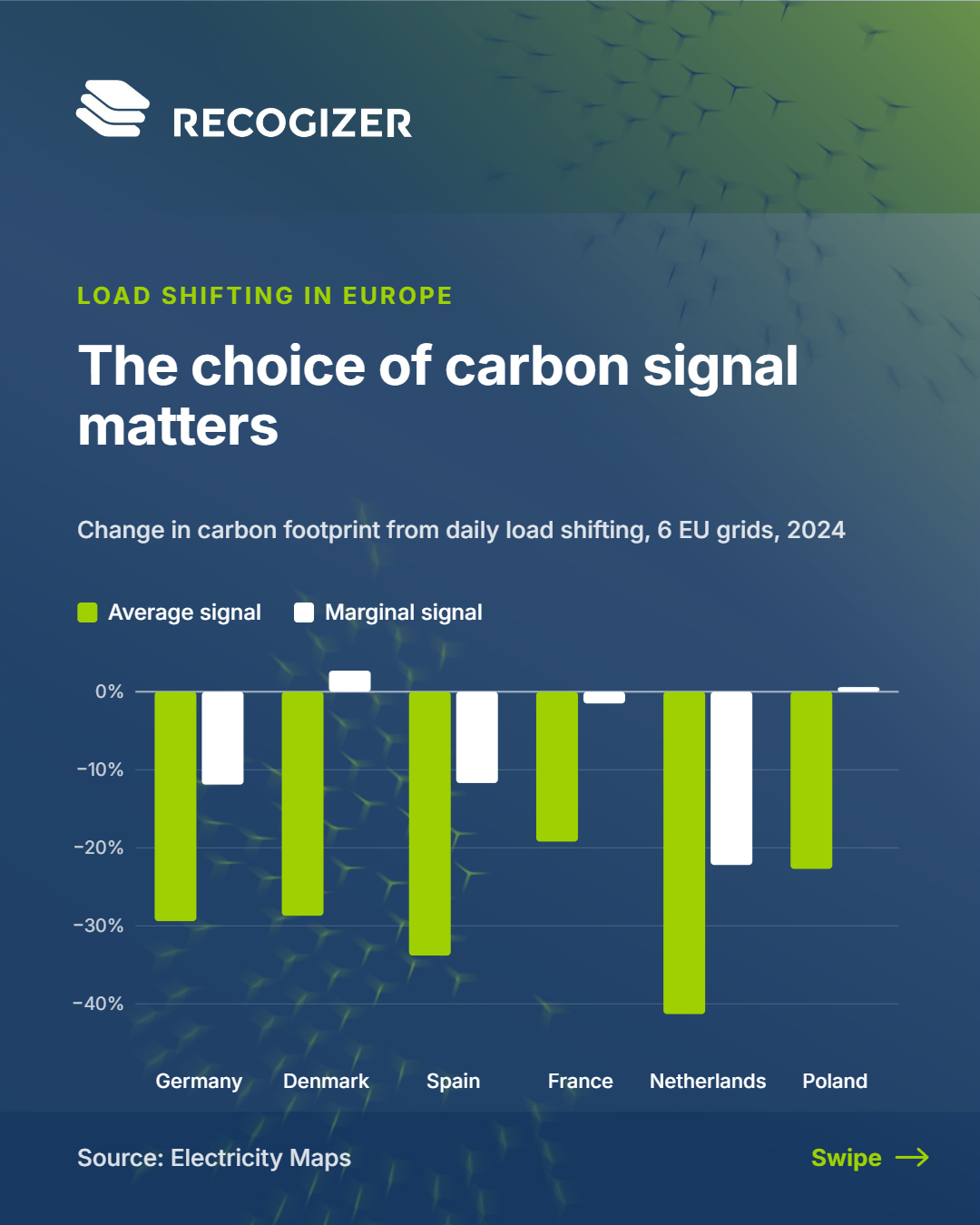
Another study published by researchers from MIT and the University of Massachusetts compared two common ways of measuring grid carbon intensity, average and marginal emission factors (from Watt Time), and found the two signals are poorly correlated, meaning that optimizing for one can increase emissions as measured by the other. Building on this, the study simulated daily load shifting in 2024 across several European grids, including Germany, Denmark, Spain, France, UK, the Netherlands and Poland (Figure 1).
Shifting loads based on hourly average intensity reduced the carbon footprint in every one of these grids. Shifting based on marginal intensity, however, did not consistently reduce the footprint and even increased it in Denmark and Poland.
For asset managers, dynamic energy pricing becomes a cost lever, not a sustainability strategy. Considering energy pricing as a sustainability strategy creates two potential risks:
- overstated savings in the business case.
- CO₂ reduction claims that do not hold up in ESG reporting.
The goal is not simply to use electricity when it's cheap, since that doesn't automatically translate into lower CO₂ emissions. The real added value lies in optimizing energy price, demand charges, grid fees, comfort and carbon intensity at the same time, and in making the trade-offs between them transparent. That's where Recogizer comes in: it helps asset managers generate energy savings, improve building operations, and enhance tenant comforts an AI-powered building automation system, it improves indoor air quality and tenant well-being while cutting energy use, operating costs, and CO₂ emissions, so asset managers can make the most of every kilowatt-hour without trading comfort for efficiency.
Reach out to our team if you want to dive deeper into the topic and join our future webinar!
back to overview